Our Services
Our Brochures
Air Con Recharge (Air Con Regas)
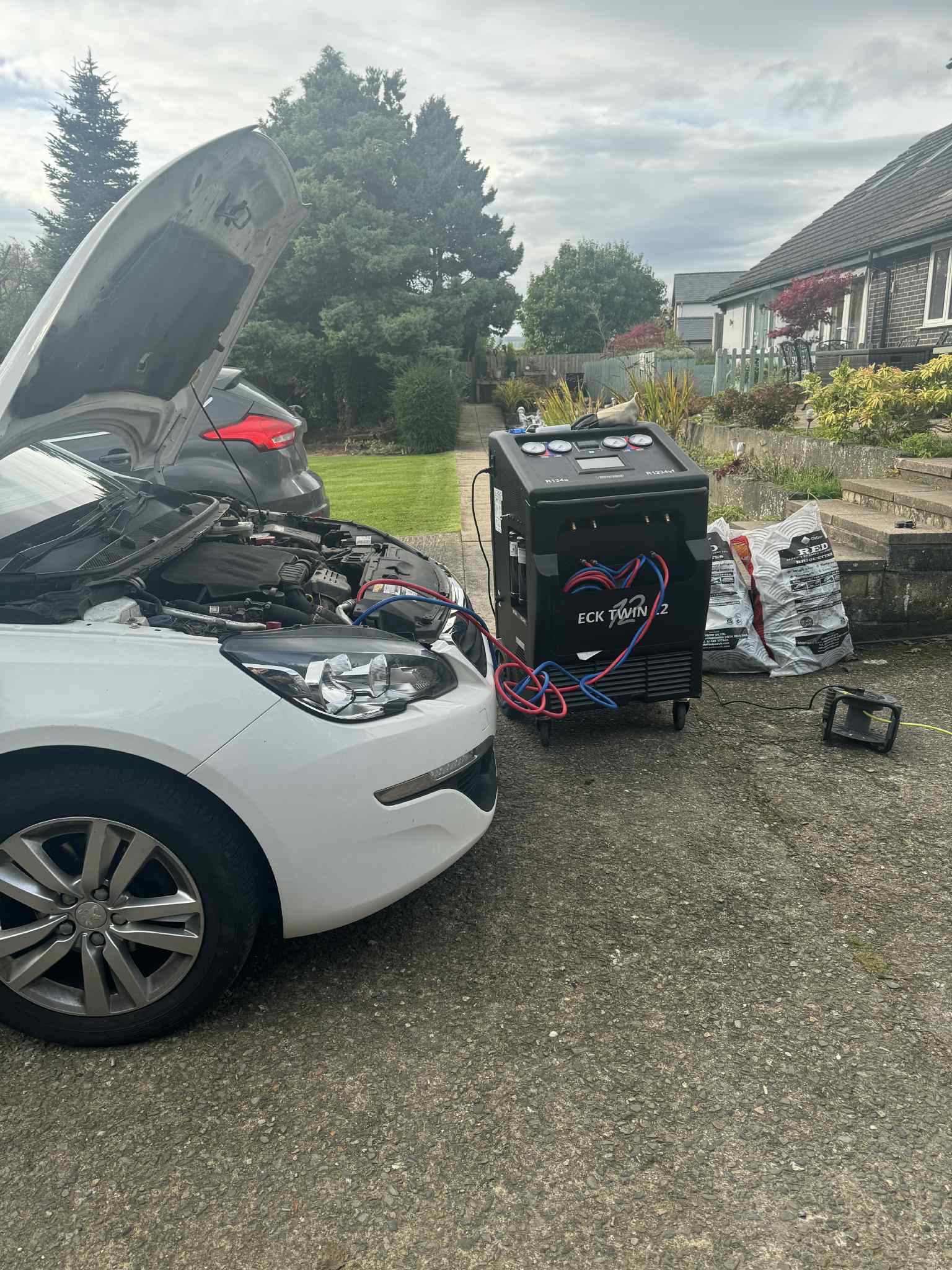
An air con regas is a process of recharging a car's air conditioning system by removing the old refrigerant gas and replacing it with new refrigerant and lubricant.
This restores the system's efficiency and the ability to blow cold air, which is often lost over time as gas naturally depletes from system. Naturally through depletion it can loose upto 10% efficiency within 2 years so maintaining the system helps with keeping components operating as they should.
A regas also includes a vacuum test for leaks (not a guaranteed leak check) and a performance check to ensure operating efficiency.
System not operating?
If your system is not operating correctly then it may just be low on refrigerant or possibly have a leak. We use nitrogen/hydrogen blend to pressurise the ac systems to identify if any leaks are present as it is illegal to regas a vehicle knowing it has a leak.
If a leak is found we use a sniffer to show where leak is found and discuss repairs with our customers.
What’s included?
- Pressure check to see if vehicle has any refrigerant or see how the system is functioning
- Full recovery carried out to remove any refrigerant
- Full vacuum to ensure all moisture is removed and a vacuum leak hold is performed at the end
- Replenishment of oil to ac system as sometimes on recovery oil is discharged.
- Recharge performed to manufacturer levels
What is Regassing?
What is regassing?
Air-con regassing is the process of removing the old refrigerant from your air conditioning system and replacing it with new refrigerant, so your air con can run cold again. It should be the first thing you explore if your air-con system isn’t blowing as cold as it should.
How do you know when your air-con needs regassing?
The first sign that your air-con needs regassing is that the air being blown from the vents is not as cool as it used to be, or it doesn’t feel any different when the AC is switched off.
If you can’t remember the last time the system was regassed, it’s probably worth doing.
How often should you get your air-con regassed? When should it be serviced?
Most manufacturers recommend you service your car’s air-con every two years or so, but many people wait until it’s not blowing cold air.
This is unlikely to cause any harm, but bear in mind that poorly-functioning air-con will make it more difficult to demist windows in winter and could work the engine harder, thus using more fuel, so it’s not worth putting off a system check.
How long does it take to re-gas my car’s air-con?
It usually takes around 60 minutes to complete a re-gas on your vehicle’s air-conditioning system if it is fault-free.
What happens if I don’t regas my air-con system?
If you don’t regas the air-con system, it will gradually become less efficient, making the car uncomfortable in hot weather, and take longer to demist the windows in winter.
Not regassing your air-con system will be bad for it in the long run, too, with pipes likely to crack and parts likely to seize up if it isn’t used.
What else do I need to consider about my car’s air-conditioning and how do I maintain it?
As well as getting the system re-gassed, the best way to keep your air-con in top form is to use it all year round.
Change the cabin filter regularly, and consider an anti-bacterial clean if you notice musty smells coming from the vents.
The reason for this is because it’s estimated that your car permeates between 10 % of gas from the system every year; and that’s before you’ve even used it!
An air-con service also presents a good time to get the system de-bugged, which essentially decontaminates the whole system. This is recommended because aspects of the air-conditioning system are a breeding ground for bacteria, which in turn leads to bad odours.
Note: Ignoring a bacteria build up in your air-conditioning system can potentially have an adverse affect on allergies.
Change the cabin filter regularly, and consider an anti-bacterial clean if you notice musty smells coming from the vents.
The reason for this is because it’s estimated that your car permeates between 10 % of gas from the system every year; and that’s before you’ve even used it!
An air-con service also presents a good time to get the system de-bugged, which essentially decontaminates the whole system. This is recommended because aspects of the air-conditioning system are a breeding ground for bacteria, which in turn leads to bad odours.
Note: Ignoring a bacteria build up in your air-conditioning system can potentially have an adverse affect on allergies.
Re-Gassing Hybrid/Electric Vehicles
What’s so special About Hybrid and electric
They will be either of the gasses above, but most have an electric pump rather than the normal mechanical pump, it is imperative that the lubricants added are a special non conductive oil.The air conditioning compressors in hybrid and electric vehicles are operated by an electric motor instead of a drive belt.
The motor’s insulated windings are immersed in the compressor’s lubricating oil. The oils used in these compressors are formulated to have high dielectric properties, that makes them non-conductive.
Denso has recently produced a chart showing that as little as 1% contamination by improper oil can reduce the dielectric properties.
If a different type of oil gets into one of these compressors, and if the insulation on the windings has become damaged or compromised, a variety of problems may occur;
● The greatest risk of a Hybrid Electric A/C System is that if the incorrect type of PAG Oil is used, it may conduct high voltage to the compressor case or connected components. A person may receive an electric shock if they touch the compressor or engine and an appropriate ground, and components will be damaged.
●The A/C System on a Hybrid or Electric vehicle is not only there to give cabin comfort, the system is essential in providing cooling to both the Electric Motors and Axles, and the Battery Systems, both of which produce large volumes of heat in use, and without working, efficient A/C Systems will overheat and fail.
● Sensors in the compressor case can detect very small voltage leaks. Once a leak is detected, the control system will shut down the compressor.
Some hybrid vehicle manufacturer service bulletins suggest replacing all of the A/C system components if oil contamination has occurred.
And, some equipment used to repair R-134a systems may introduce unacceptable oil when it is also used to charge refrigerant into a hybrid vehicle with an electrically driven compressor. Residual incorrect oil may remain in the equipment’s hoses and internal plumbing, and be delivered into the hybrid vehicle during the charge process.
Over the years, equipment manufacturers have introduced new recovery/recycling/recharge (RRR) machines that are acceptable both for use on hybrid vehicles with electrically driven compressors and for use on conventional A/C systems.
These RRR machines have a separate SAE specification J2788H and are designed to prevent oil from mixing with the refrigerant during charging. J2788H machines do not have oil injection capability, thus preventing the possibility of oil being dispensed from the machine.

The motor’s insulated windings are immersed in the compressor’s lubricating oil. The oils used in these compressors are formulated to have high dielectric properties, that makes them non-conductive.
Denso has recently produced a chart showing that as little as 1% contamination by improper oil can reduce the dielectric properties.
If a different type of oil gets into one of these compressors, and if the insulation on the windings has become damaged or compromised, a variety of problems may occur;
● The greatest risk of a Hybrid Electric A/C System is that if the incorrect type of PAG Oil is used, it may conduct high voltage to the compressor case or connected components. A person may receive an electric shock if they touch the compressor or engine and an appropriate ground, and components will be damaged.
●The A/C System on a Hybrid or Electric vehicle is not only there to give cabin comfort, the system is essential in providing cooling to both the Electric Motors and Axles, and the Battery Systems, both of which produce large volumes of heat in use, and without working, efficient A/C Systems will overheat and fail.
● Sensors in the compressor case can detect very small voltage leaks. Once a leak is detected, the control system will shut down the compressor.
Some hybrid vehicle manufacturer service bulletins suggest replacing all of the A/C system components if oil contamination has occurred.
And, some equipment used to repair R-134a systems may introduce unacceptable oil when it is also used to charge refrigerant into a hybrid vehicle with an electrically driven compressor. Residual incorrect oil may remain in the equipment’s hoses and internal plumbing, and be delivered into the hybrid vehicle during the charge process.
Over the years, equipment manufacturers have introduced new recovery/recycling/recharge (RRR) machines that are acceptable both for use on hybrid vehicles with electrically driven compressors and for use on conventional A/C systems.
These RRR machines have a separate SAE specification J2788H and are designed to prevent oil from mixing with the refrigerant during charging. J2788H machines do not have oil injection capability, thus preventing the possibility of oil being dispensed from the machine.